DUNE
Regular price


Best sellers


La Maison Isidore Leroy
Discover the story of the house of Leroy, from its first printing machines to contemporary panoramic designs.

A history shaped by technological advances.
Care in every wallpaper.
From our archives to contemporary creations.
The Isidore Leroy story

1842
At the beginning of the 19th century, the wallpaper industry stagnated, struggling to adapt to industrialisation due to the technical difficulty of mechanisation. In 1842, Louis Isidore Leroy revolutionised the sector by inventing machines allowing continuous, multi-colour printing, inspired by textile techniques. Thanks to him, production fully entered the industrial era. The company experienced rapid growth: awards at the 1855 and 1867 Universal Exhibitions, patented innovations, and the diversification of its collections. It established itself as a key player in the technical and artistic renewal of wallpaper.

1876
Louis Isidore handed the company over to his son Charles in 1879. During the Belle Époque, the company prospered by embodying luxury and ostentatious comfort, remaining at the forefront of style thanks to its fashionable designers and artists. As an international company, Isidore Leroy exported a quarter of its production. In 1912, a factory was built in St Fargeau Ponthierry, which is now preserved and open to visitors.

1920
In the 1920s, the Leroy house reached its peak, drawing inspiration from Art Nouveau and Art Deco movements. Its creations adopted an aesthetic based on constructive logic and an abundance of geometric shapes such as circles, triangles, and diamonds. These motifs evoke the movement and dynamism of an enthusiastic generation discovering the airplane, the automobile, and the pleasures of sport.

1969
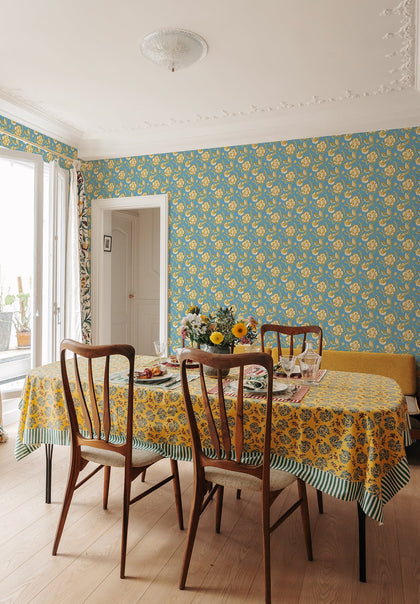
During a period of prosperity, wallpaper became a staple in homes, driven by colourful and floral styles. Isidore Leroy took advantage of this to innovate with bold collections, including the success of the Twin Set and non-woven wallpaper starting in 1972, reaching its peak in 1970 as the European leader. However, the late 1970s were marked by the Wallpaper Crisis, which saw the disappearance of most French manufacturers. Rising costs and foreign competition forced the Leroy Manufacture to temporarily close in 1982.

2016
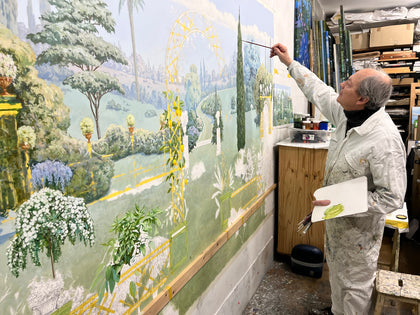
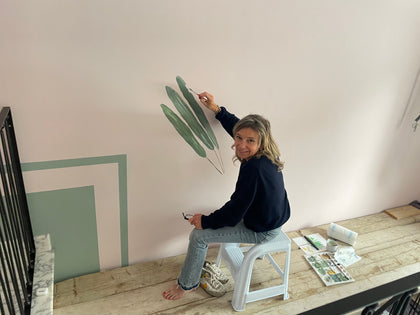
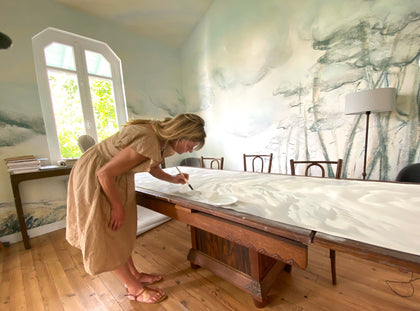
In 2016, the brand was reborn in Bordeaux. Driven by new printing techniques and a dynamic team, it multiplied collaborations with renowned designers and quickly became a key player in decoration once again. By mastering the entire production process in its workshops, it remains faithful to its heritage. It rediscovers its archives, restores its legacy, and also offers customisable panoramic designs created with contemporary artists.
The art of making wallpaper
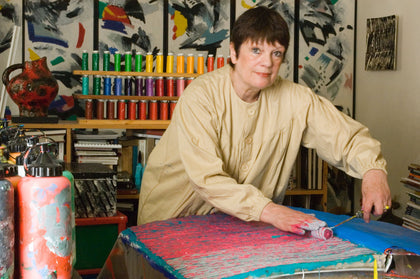
Ink is applied to paper using relief rollers. This traditional process gives wallpaper a distinctive texture that is both tactile and luminous.
Digital printing reproduces the colors and detail of contemporary designs as well as patterns from the house’s archives.